
The first time someone quoted me lumber in board feet, I nodded like I understood. I didn't. I went back to the office and worked it out on paper, and I got it wrong twice before it clicked. If board feet confuse you, you're in good company. Here's the simple version.
What a board foot is (in plain words)
A board foot is a chunk of wood volume. Picture a piece 12 inches long, 12 inches wide and 1 inch thick. That's one board foot. That's it.
The shape doesn't matter, only the volume. A board 2 inches thick and 6 inches wide, one foot long? Also one board foot. Same amount of wood, different shape. Once that sinks in, the rest is easy.
The formula
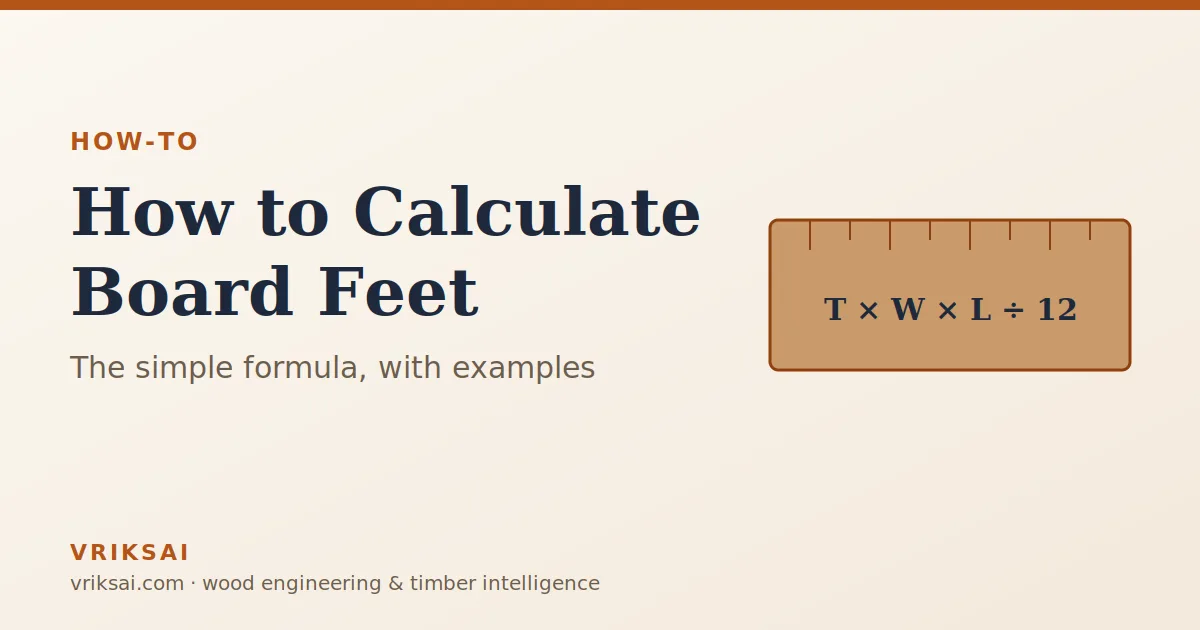
Take the three measurements and multiply:
Board feet = (thickness in inches × width in inches × length in feet) ÷ 12
Notice the mix — thickness and width in inches, but length in feet. This trips people up more than anything else. The trade has always done it this way, so we live with it.
Let's do one together
Say you have a plank of American walnut: 2 inches thick, 8 inches wide, 10 feet long.
2 × 8 × 10 = 160. Divide by 12 and you get 13.33 board feet. If walnut is $12 a board foot, that plank costs $160. Done.
Now try a full lift of 40 such planks: 13.33 × 40 = 533 board feet. See how fast a quote comes together once you have the number per piece?
Where people lose money
I've watched buyers make the same handful of mistakes for years. These are the ones that hurt:
Measuring length in inches. If you put length in inches instead of feet, your answer is twelve times too big. You'll think you're getting a bargain. You're not.
Nominal versus actual size. A "2x4" from a shop is not 2 inches by 4 inches — it's closer to 1.5 by 3.5 after planing. Hardwood sold rough is usually measured before planing, so ask which size the seller means. Sellers know the difference. Make sure you do too.
Forgetting waste. You never use 100% of a board. Knots, splits, ends, saw cuts — plan on buying 10 to 20 percent extra depending on the job. A cutting list that needs exactly 100 board feet needs an order of 115.
Board feet, CFT and cubic metres
Here in India most timber trades in CFT (cubic feet), and importers deal in cubic metres. The conversions are worth pinning on your wall:
1 cubic foot = 12 board feet. 1 cubic metre = about 424 board feet, or 35.31 CFT.
So when a mill in America quotes you $1,200 per thousand board feet, and your buyer in Delhi wants a rate per CFT, you can move between them without guessing. Mixing these up is one of the most expensive mistakes in this trade — the numbers differ by factors of 12 and 35, so an error doesn't look small, it looks catastrophic on the invoice.
A quick reference you can screenshot
These come up constantly. All per piece, 8 feet long:
| Size | Board feet |
|---|---|
| 1" × 4" × 8ft | 2.67 |
| 1" × 6" × 8ft | 4.0 |
| 1" × 12" × 8ft | 8.0 |
| 2" × 4" × 8ft | 5.33 |
| 2" × 6" × 8ft | 8.0 |
| 2" × 12" × 8ft | 16.0 |
Notice the pattern: double the thickness or the width and the board feet double with it. Once you see that, you can estimate a whole stack in your head while the seller is still finding his calculator.
One last thing
You don't need to do this by hand every time. We built a free volume converter that moves between board feet, CFT and cubic metres in one step, and our log rule calculators handle round logs. But learn the hand method once. The day your phone dies at a timber yard, you'll be glad you did.